A dealer friend recently commented, “It’s been too easy, and we have developed some bad habits in our sales department over two years.” It’s understandable how it can happen, but let’s address sooner rather than later.
The 15 years I spent in an ag equipment dealer sales department were full of challenges and opportunities. However, the most satisfaction was derived from when sales opportunities were not easy… every sales opportunity needed our best effort and the details mattered. While the margin wasn’t always the best, we found victory in converting sales opportunities. It may be worthwhile to review what it is that differentiates your dealership and its products versus the competition. Merely having the right piece of equipment is not going to be enough. We need to renew our “for better or worse” vows and be prepared for a set of challenges that we haven’t seen for a while, nor have many (like me) experienced in our time in the dealership.
Interest Rate Implications
It might feel like we are experiencing one of those warm, humid, summer days where the weather is enjoyable, but we aren’t certain if a storm could brew up. We don’t know exactly what might happen, but we have some factors that should put us on alert.
While still historically low, we haven’t had these kind of interest rates since late 2006 and early 2007. The spike in interest rates that occurred then was very short term. We are likely to see more sustained rates. A lot of my friends on dealer management teams, including myself, have never had the challenge of interest rates that are sustained over 5% (using the Fed Funds Rate). My unofficial dealer poll finds floor plan interest rates ranging from 6.5% to 7%.
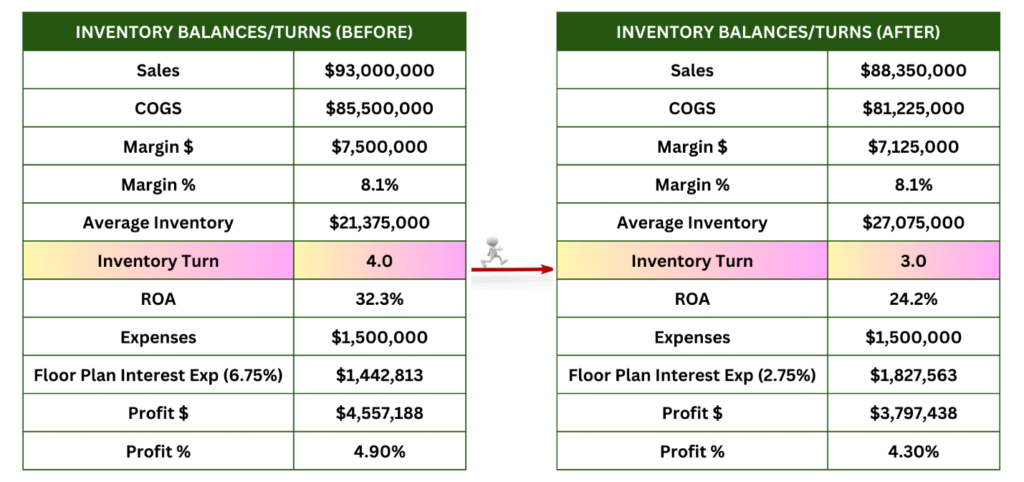
Additionally, it is important to acknowledge that certain retail finance “tools” for moving through some of the used equipment may not be available like it was 2013 through 2015. For example, ultra-low interest loans and low lease rates were a great tool to use back then. They are not likely to be available to our industry to the same extent this go around. For now, we will keep that in mind, but for the exercise below, we will focus on the implications of 2.75% vs. 6.75% interest carrying costs for the dealership, assuming everything else being equal.
Used Equipment Turns
We used to joke about needing to focus on the “trend setting” operators to get them to buy used equipment. If we could get them on board, we knew the neighbors were watching and it would not take them long to get on board as soon as we got Mr. Trend Setter to bite. Unfortunately, the reverse can be true too. As soon as Mr. Trend Setter goes into lockdown mode, it seems like the others do too. Realizing, of course, that these equipment buyers were likely facing the same economic factors influencing their decision making, I believe there is merit to the theory. Regardless, Mr. Trend Setter seems to be cooling off on equipment investments and inventories are slowly starting to climb in a lot of market segments. In the exercise below, we’ve now added in the potential for used equipment turns to slow down by means of inventory balances creeping up and sales softening.
Declining Values
We can be thankful our industry is one that doesn’t accumulate inventory overnight. The bad news is that dealers have likely committed to trades that won’t become available and on the books for 6 to 12 months. It certainly could stay strong or even improve, but the sentiment seems to be that we are more likely to see equipment values soften. The nature and extent of that change is to be determined, but a 10% decline in used equipment value is not a small amount of money. Dealer balance sheets are in good shape, but it does not mean it should be fun. If the inventory starts to grow and/or values start to soften, it is not likely to cure itself overnight either. For this exercise, let’s add in the potential for margin going from 8.1% to 4.05%, where we’re now selling the same amount of equipment at a lesser margin.
*Some may do a cost adjustment to write their inventory down or take other actions. In the end, the concept is the same. Values/Margins could decline, with impact to the bottom line.
Have Your Toolbox Full
Of course, I have tried to keep this exercise simple. You can apply your thoughts and/or data to this simple tool. This also does not mean to suggest we are all doom and gloom. These are exciting times with the advancement of technology and a generally positive long-term outlook for agriculture. However, we do need to prepare ourselves and have all the tools available to help close deals. What does that mean?
- Value Selling Skills – Does your sales team talk through the added value that can be gained to entice a customer to trade? Is your sales team able to talk through the potential return on investments of various products? Can they compare the potential return on investments of the customer’s current equipment vs. your competitors vs. what you are offering? As ridiculous as it may seem, I have heard the line, “that’s what corporate told me” when trying to justify a trade difference. This maybe worked the past two years. I don’t think this line is particularly effective in the long term.
- Equipment Finance Solutions – Do you have all the pieces in place to use various finance solutions to help close deals? Who handles putting together financing in your dealership? If you do not have a dedicated person, are others aware of all the solutions available to meet the specific situational needs of the customer? Do you have solutions for lesser credit quality? Do you have lease products for competitive trades? Do you have solutions for out of territory customers? Do you have solutions for your short line offerings? Or are you turning people away because of gaps? Or suggesting they find financing on their own? As crazy as it is, this happens. Make sure you have the right finance solutions in place through your captive and finance partners to help close deals.
- Demo Opportunities – Does your sales team have the training and skillset in order to do effective demos? Or do you have the resources internally to have someone internally committed to doing customer demos? Are you able to qualify a buyer such that “pending a successful demo” you have a deal in place for your trade proposal?
- Reconditioning – I understand your shops are full and often the sales department’s equipment will get placed on the back burner. In some instances, rightfully so. As sales get tougher to come by, customers have increased options on the equipment they decide to purchase, and as interest rates rise, I would argue the sales equipment cannot occupy the back lot for 3 months before it gets touched. Processes must be in place to at minimum get equipment standing tall (washed and detailed), have an inspection completed so you know what you have and can make informed decisions when negotiating deals, and ensure fluids and filters past half-life get changed. Remove as many cost-effective objections as possible in a timely manner and be confident and knowledgeable of the equipment being offered for sale.
- Warranty Solutions – How do you provide your customer with some assurance and peace of mind regarding your used equipment? Are you going to offer an extended warranty? Or do you offer some other form of assurance? If so, what does that look like? It’s important to have a plan in place so the sales team knows what options can be made available to customers. Some equipment buyers are naturally risk adverse. Others are looking at your equipment versus alternatives that might have a warranty. Identify the reasons a customer might not buy something. Knowing your equipment and having solutions prepared for how to remove the objection of a risk adverse buyer can be a differentiator.
Much of this is similar to what the ag industry went through from 2012 to 2014. The primary differences, however, should be noted. We have had a much faster inflation of used equipment prices that could fall more drastically, and interest rates will impact the inventory carrying costs, as well as what tools are available to us. Of course, hindsight is always going to be 20:20. At minimum, hopefully this exercise causes some reflection on having all the right tools and resources available to help maximize sales opportunities. If it is going to storm on us for a bit, let’s not let it wash away more margin or dealer reserves than necessary.