A Letter to Our Readers
Equipment has never been more capable, more productive, or more expensive than it is today. At the same time, the decisions surrounding equipment ownership have become increasingly complex.
For producers, every equipment decision affects profitability, cash flow, productivity, and risk. For equipment dealers, helping customers navigate those decisions has become just as important as the machines themselves. Whether the conversation is about trading, financing, repairing, or operating equipment longer, everyone is trying to answer the same question:
What is the best long term ownership decision? The answer is rarely straightforward. There is no universal trade interval. No single formula that applies to every operation. Every farm, every dealership, and every machine has a unique set of circumstances that influence the economics of ownership.
That is why we created this report on the True Cost of Equipment Ownership. Our goal is not to tell you when to buy, sell, trade, or repair equipment. Instead, we hope to provide objective research, practical insights, and useful tools that help you better understand the economic factors that influence those decisions.
This report combines university research, industry data, and practical operating experience to explore a topic that we believe deserves discussion within the industry. We don’t claim to have all the answers, but we have always enjoyed learning, asking questions, and trying to better understand the economics behind equipment ownership. If this report helps spark new ideas or provides a useful perspective as you make decisions for your operation or your customers, then it has accomplished its purpose.
Through Machinery Scope, we have the privilege of working with equipment owners, dealerships, lenders, repair facilities, and other professionals across agriculture every day. Those conversations continually reinforce one belief: the strongest operations are built through thousands of informed decisions made over time, not a single transaction.
Thank you for taking the time to read this report. We appreciate the opportunity to share, and we hope you find the information both valuable and thought provoking.
Sincerely,
Jacob Bryce
Founder & President
Machinery Scope
Summary
Equipment ownership decisions are among the largest financial decisions made on most farms. Recent university research demonstrates that depreciation is heavily front loaded, but depreciation alone does not tell the entire ownership story. This report introduces a broader framework that considers depreciation, maintenance, capital costs and component failure risk.
Six Key Considerations
- Depreciation is only one component of equipment ownership cost.
- Depreciation is heavily front loaded. During the first 500 hours, the estimated decline in auction value per additional operating hour is more than four times the rate at 1,000–2,500 hours and nearly six times the rate at 2,500–5,000 hours.
- Maintenance costs and major component failure risk increase with age and use. As equipment accumulates hours, routine maintenance expenses tend to rise while exposure to larger, less predictable repairs becomes increasingly important considerations to the overall cost of ownership.
- Capital carrying costs may decline as equity increases, but cash invested in equipment still carries an opportunity cost because it cannot be used elsewhere in the operation.
- Downtime can create significant operational and financial consequences. Although the impact varies by operation and season, it should be considered alongside repair costs. A planting downtime calculator is included for illustration.
- No single ownership strategy is best for every operation.
Equipment Depreciation: What Research Shows
A recently published study by researchers from Purdue University, Kansas State University, and Tractor Zoom analyzed more than 6,800 auction sales of 300 to 450 horsepower tractors to better understand the factors that influence tractor values.
Importantly, the researchers evaluated both age and operating hours. Their model controlled for machine age, horsepower, drivetrain configuration, brand, auction timing, and broader market conditions, allowing them to estimate the incremental effect that additional operating hours have on auction value.
The results show that the value of each additional operating hour is heavily front-loaded. After controlling age and other factors, the researchers estimated that auction values declined from $118 per hour on machines with less than 500 hours to $20 per hour on tractors from 2,500 to 5,000 hours.
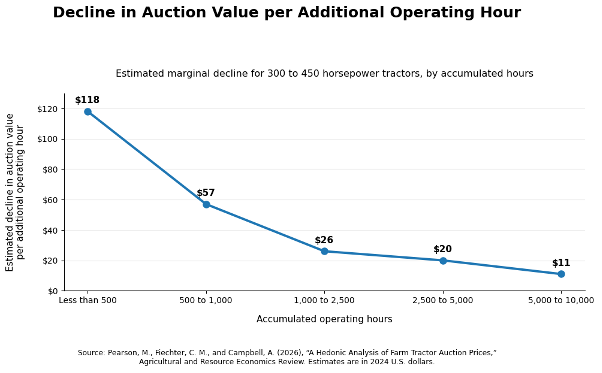
This distinction is important. The study does not suggest that operating hours alone determine depreciation, nor do these figures represent the total annual cost of depreciation. Rather, they estimate the incremental impact of additional utilization on equipment value, after accounting for age and other factors.
In practical terms, adding hours to a low hour tractor can have a substantially greater impact on its value than adding the same number of hours to a higher hour tractor. This can be particularly useful when evaluating trade values, projected utilization, and equipment replacement decisions.
The findings also align closely with what we have observed through years of equipment appraisal experience, both within equipment dealerships and through Machinery Scope. Understanding that the value impact of additional hours changes considerably throughout a tractor’s life provides another useful perspective when evaluating equipment ownership economics.
Source: Pearson, Madison; Fiechter, Chad; and Campbell, Andy, “A hedonic analysis of farm tractor auction prices” (2026). Department of Agricultural Economics Faculty Publications. Paper 42. https://docs.lib.purdue.edu/agedocs/42
Looking Beyond Depreciation
The Purdue University, Kansas State University, and Tractor Zoom research provides valuable insight into how operating hours affect tractor resale values. Hourly depreciation, however, is only one component of equipment ownership.
Depreciation itself is influenced by more than operating hours. Equipment also loses value as it ages, and resale values can be affected by configuration, condition, specifications, technology, brand, and changing market demand. Features such as wheels versus tracks, transmission and hydraulic configurations, tire or track configurations, and other options can materially influence both initial cost and resale value. Understanding depreciation therefore requires considering both the passage of time and utilization, along with the characteristics and marketability of the individual machine.
Beyond depreciation, producers must also consider capital carrying costs, maintenance expense, the risk of major component failures, and the productivity benefits associated with newer equipment. These factors do not move in the same direction throughout a machine’s life.
As depreciation moderates over time, maintenance costs and repair exposure generally become more significant. Capital carrying costs may also decline as equipment value and debt balances decrease, although equipment continues to represent invested capital and associated opportunity cost.
Evaluating any one of these factors in isolation can therefore produce an incomplete picture of ownership economics. A more meaningful analysis considers how they interact over the life of the machine.
There is no single ownership strategy that is appropriate for every operation. The optimal decision depends on equipment utilization, financial objectives, technology requirements, and each producer’s tolerance for repair risk.
Building the Machinery Scope Ownership Model
To better understand total ownership costs, Machinery Scope developed an ownership model that expands upon the university research. Rather than evaluating depreciation on an hourly basis alone, the model considers three additional cost categories:
- Capital / opportunity cost
- Maintenance expense
- Major component failure risk
The Machinery Scope Ownership Model combines practical operating experience, including equipment appraisals, dealership service experience, farm maintenance records, Machinery Scope claims data, and a standardized set of ownership assumptions. The purpose is not to predict the ownership cost of every tractor, but to illustrate how the major cost categories change throughout a machine’s life. The model assumes a 325 to 350 horsepower wheeled row crop tractor operating approximately 350 hours per year under normal agricultural conditions and applies a 6% non-subsidized cost of capital. While actual ownership costs will vary by machine and operation, these assumptions provide a consistent framework for illustrating how ownership costs evolve over time.
| Assumption | Model Input |
| Annual Utilization | 350 Hours |
| Cost of Capital / Opportunity Costs | 6% (non-subsidized) |
| Maintenance | Manufacturer recommended maintenance, including allocating costs for replacing tires, batteries, and other maintenance and wear items. |
| Repair Risk | Probability based estimate that includes all factory components required to properly operate the machine according to its original design intentions. |
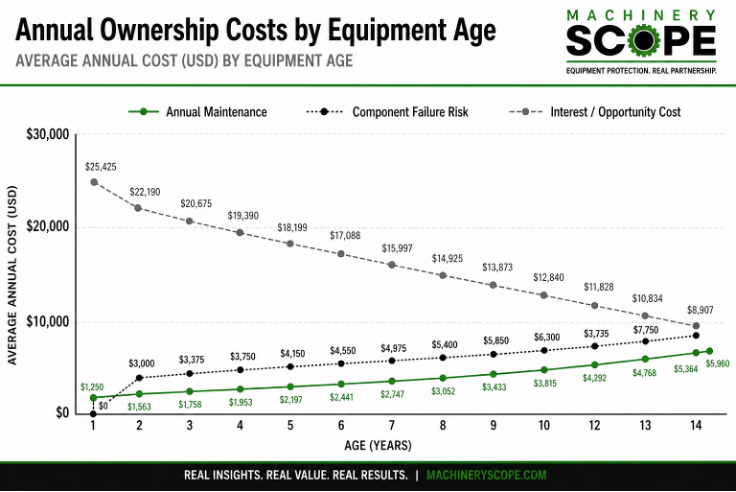
The Ownership Cost Curve
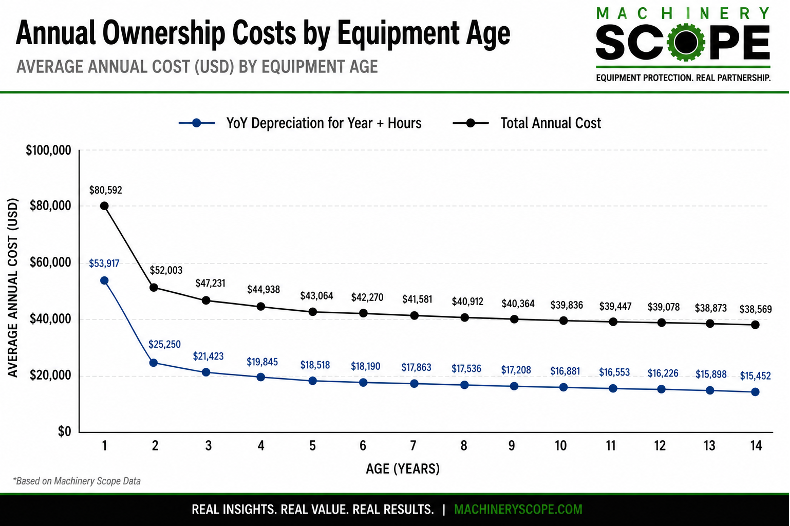
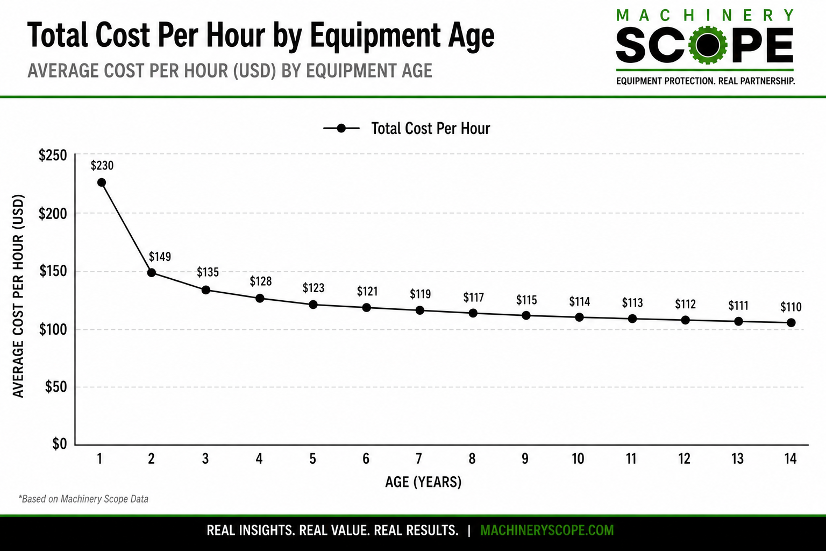
The Machinery Scope ownership model demonstrates that equipment ownership costs evolve throughout a machine’s life.
During the early years of ownership, depreciation and capital carrying costs generally represent the largest share of total ownership cost. As those costs decline, maintenance expense and the expected cost of repairs for component failures become increasingly important.
The result is an ownership cost curve in which the composition of costs changes over time. Rather than focusing on a single expense category, producers can evaluate how the complete cost structure shifts as a machine ages.
The purpose of the model is not to recommend trading equipment sooner or operating it longer. Instead, it provides a framework for understanding the economic tradeoffs associated with different ownership strategies, allowing each operation to make decisions based on its own financial objectives, utilization, and tolerance for repair risk.
The Cost of Downtime
The final consideration in equipment ownership is downtime.
Unlike depreciation or maintenance costs, the financial impact of downtime depends on when it occurs and the role that machine plays within an operation.
A breakdown on a secondary tractor during the off season may have little impact. The same failure on the only tractor capable of pulling the planter during a narrow planting window could have significant economic consequences. Because every operation is different, there is no universal cost of downtime. To help producers evaluate that impact for their own operation, Machinery Scope developed the Planting Downtime Calculator, which uses University of Minnesota planting date research to estimate the potential revenue implications of planting delays under a variety of operating scenarios.
Download Machinery Scope Downtime Calculator
Corn Planting Delay Calculator
Estimate the yield and revenue cost of equipment downtime during planting, based on University of Minnesota planting date research.
Your operation
Key results
- Expected bushels lost
- 0
- Corn acres remaining
- 0
- Planned completion date
- —
- Delayed completion date
- —
How the calculator works
This is for illustrative purposes only. The model divides the remaining corn acres into daily planting blocks based on planting capacity. It compares each block’s Study 2 yield potential under the planned schedule with its yield potential after the entered downtime. The difference is converted into bushels and crop value. This avoids assuming every remaining acre suffers the same loss. Instead, each part of the schedule shifts into the respective delayed yield % curve.
| Planting day | Acres in block | Planned date | Delayed date | Planned yield % | Delayed yield % | Bushels lost | Revenue impact |
|---|
Model limitations and source
Yield potential is based on average University of Minnesota Study 2 results from Lamberton, Morris, and Waseca (2009–2011), with daily values linearly interpolated between published observations. Actual results vary with soil conditions, weather, hybrid, field location, emergence, and management. This estimates planting date opportunity cost only, and excludes repair expense, labor, fuel, drying cost, insurance, basis, and other operational impacts. It is an illustration, not a guarantee for any individual field or year. Source: University of Minnesota Extension
It is also important to consider how an operation would realistically respond to extended downtime. If the potential economic loss from leaving a machine out of service exceeds the cost of renting or otherwise securing a replacement, the practical cost of downtime may be closer to the cost of that alternative. In many situations, securing another tractor and keeping the operation moving may be far more economical than absorbing the full potential impact of the delay.
The calculator is intended for illustrative purposes only. Actual yield response to delayed planting will vary by region, soil type, weather conditions, crop, hybrid selection, and management practices. While this example focuses on corn planting, the same concept can be applied to other critical field operations such as spraying and harvest. The objective is not to predict the exact cost of downtime, but to provide a practical framework for evaluating how equipment downtime can influence the overall economics of an operation.
Conclusion
Equipment ownership is more complex than any single metric can capture. Depreciation, capital investment, maintenance, repair risk, and downtime all influence the economics of owning and operating machinery, and the importance of each changes throughout a machine’s life.
There is no universal ownership strategy or ideal trade interval. The best decisions are those made with a clear understanding of the tradeoffs and how they align with the goals, resources, and priorities of each operation.
We hope this report provides a useful framework for evaluating those decisions and contributes to the ongoing conversation about the economics of equipment ownership.